
Allegany County Court Records After a Jail Arrest
The arrest-to-court path in Allegany County, New York usually runs from an arresting agency to the Allegany County Jail, then to a local criminal court, the Allegany County District Attorney's Office, and the court clerk. Sheriff Scott A. Cicirello's office operates the jail and the current custody roster, but the court records after a jail arrest are shaped by the accusatory papers and court activity that follow booking. District Attorney Peter Degnan's office prosecutes county cases, including felonies, misdemeanors, violations, and traffic infractions.
The jail side and the court side should be checked separately. Use jail inmate records for custody status, the roster, booking fields, and VINELink status-change links. Use jail mugshots for booking-photo posture and photo requests. Court records after an arrest are different because they track filed charges, court dates, motions, dispositions, sentencing, and sealing status.
For local source context, the Allegany County Court page lists the county courthouse, felony jurisdiction, hours, judges, and clerk contacts. The official Town and Village Court Schedule helps identify the local court shown on an appearance ticket or bail paperwork, and the Allegany County Clerk court-filings page explains County and Supreme Court filing responsibilities.
How to Find Allegany County Court Records After an Arrest
Start with the jail record only to confirm the person was booked and to copy the visible charge code, description, inmate ID, and bond type. Then move to the court record. New York's WebCriminal portal is the public starting point for many pending criminal matters, while older files, clerk copies, or records not online may require contacting the appropriate court or clerk directly.
- Open New York WebCriminal and choose Case Identifier, Defendant, or Court Calendar.
- Search by defendant name or case identifier, using the court name from the ticket, bail paperwork, or roster detail when available.
- Open the case result and compare the filed charge list with the charge language that appeared at booking.
- Check each charge's code, offense level, next appearance, disposition, and current status instead of assuming the booking charge is final.
For official criminal-history information, New York Courts describes clerk requests and CHRS searches on its court records help page. DCJS fingerprint-based record review is a separate path for a person seeking their own rap sheet. Allegany County's FOIL page is useful for agency records, but it states that County Clerk records, including court records, are not handled through that county FOIL form.
The New York Courts WebCriminal portal presents search categories for case identifier, defendant, and court calendar lookup.
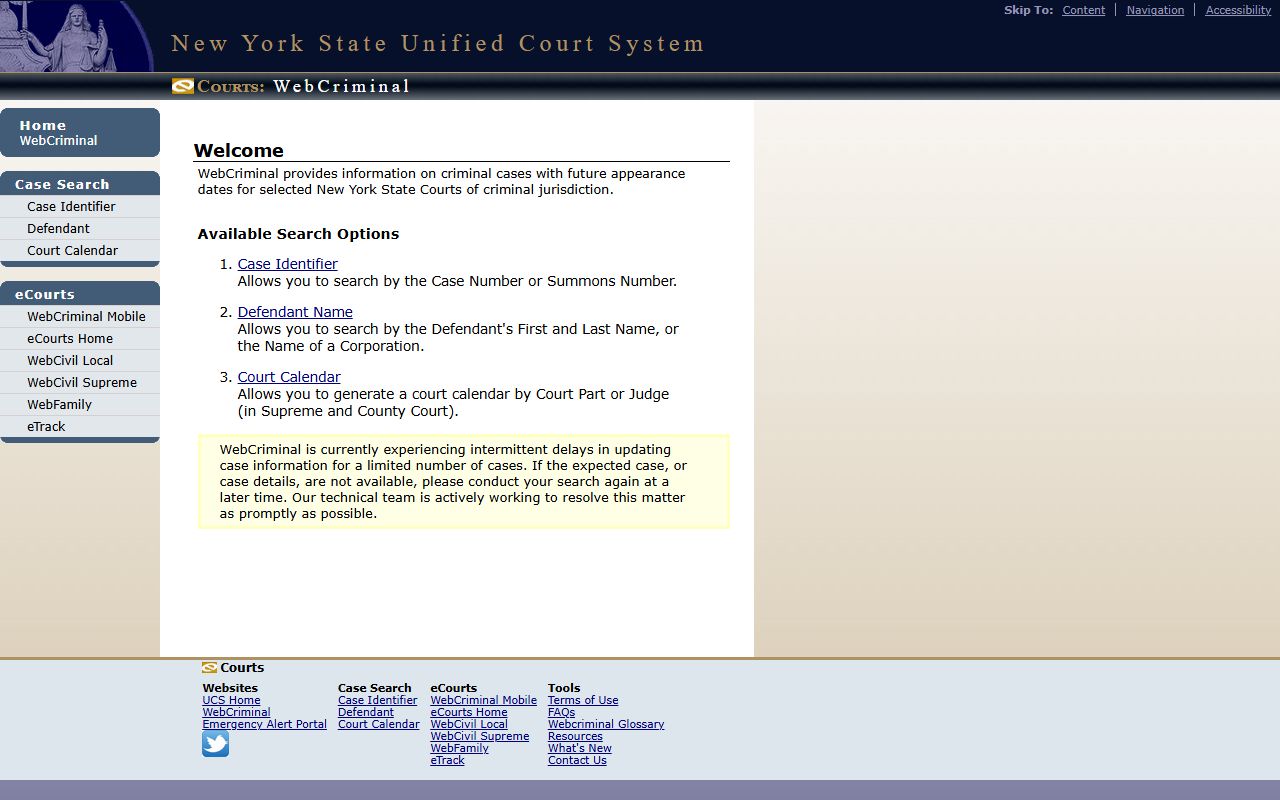
That statewide portal is the bridge between a jail arrest and the public criminal case, while local clerks remain the source for official copies and court-specific questions.
How Charges Get Filed After an Arrest: Complaint, Information, and Indictment
Booking records often reflect the arresting agency's intake information. The court record begins when an accusatory instrument is filed and the case is placed before a court. In Allegany County, misdemeanor and minor-offense matters may proceed in local criminal courts, while felony trials are handled in County Court. The District Attorney may appear at arraignments, motions, pre-trial practice, trials, sentencing, and grand jury proceedings.
| Complaint | Information | Indictment | |
|---|---|---|---|
| Filed By | Officer, complainant, or prosecutor depending on the instrument | Prosecutor or authorized complainant for a prosecutable local-court charge | Grand jury after presentation by the prosecutor |
| Common For | Initial misdemeanor or felony-complaint filing after arrest | Misdemeanor prosecution in local criminal court | Felony prosecution in County Court |
| What It Starts | The first criminal case record and early appearances | A case that can move toward plea, trial, dismissal, or other disposition | A felony case that replaces or supersedes earlier complaint-stage charges |
Charge Status and What It Means
Charge status can change after the arrest. A roster may show a booking charge, but the prosecutor may file a different offense, amend a count, reduce it for plea purposes, add a count, or dismiss it. Read each charge line separately, especially when one arrest produces several counts or when a felony complaint later becomes an indictment.
| Status | What It Means |
|---|---|
| Pending | The charge is still active and has not reached a final disposition. |
| Amended / Reduced | The original charge language or level changed, often through prosecutor action, plea negotiation, or court order. |
| Dismissed | The charge ended without a conviction on that count, though other counts from the same arrest may remain. |
| Disposed / Sentenced | The court has entered an outcome such as plea, conviction, acquittal, dismissal, or sentence. |
Bond and Release After an Arrest
Release status is a court issue, even when the roster displays a bond field. New York Criminal Procedure Law section 530.20 gives local criminal courts authority to order recognizance, non-monetary conditions, money bail, or remand when the law allows. Allegany County's official bail payment page tells users to call the Sheriff's Office/Jail Division at (585) 268-9200 before paying and says the payment workflow needs the defendant name, date of birth, inmate ID, court name, and cash bail amount.
| Bond Type | How It Works |
|---|---|
| Cash Bail | Money bail may be paid when the court has set a cash amount and the person is otherwise releasable. Allegany's card-payment path uses GovPayEXP and adds a non-refundable service fee. |
| Secured or Partially Secured Bond | A court-authorized bond may be available in some cases, but the county's official bail page emphasizes direct cash bail or fine payment by card. |
| Release on Recognizance or Conditions | The court may release a person based on a promise to return or under non-monetary conditions rather than cash bail. |
| No-Bail Hold or Detainer | A remand order, parole warrant, federal hold, immigration hold, or out-of-county detainer can keep a person in custody even when another charge line appears resolved. |
Warrants That Lead to an Arrest
An arrest warrant, bench warrant, fugitive warrant, or parole warrant can produce a jail booking and then a court record. Allegany County research located a Most Wanted quick link on the sheriff's OCV site, but no complete official searchable warrant database for the county. Treat any online wanted list as incomplete. For a bench warrant, contact the court that issued it. For custody confirmation after a warrant arrest, call the Sheriff's Office/Jail Division at (585) 268-9200 or check the OCV roster.
Warrant records may be withheld when disclosure would interfere with law enforcement. Closed or available agency records can be requested through Allegany County's FOIL process, but court records and clerk files follow court or County Clerk access rules rather than the county FOIL form.
Charges vs. Convictions
A charge is an accusation. A conviction is the result of a guilty plea or finding of guilt. This distinction matters in court records after a jail arrest because a roster may show the charge at intake, WebCriminal may show a pending case, and the final record may later show dismissal, plea, acquittal, conviction, or sealing. Do not treat arrest, charge, and conviction as the same event.
| Charge | Conviction | |
|---|---|---|
| Stage | Accusation filed after an arrest or investigation | Final guilt result by plea, verdict, or court finding |
| Proof Standard | Enough basis to accuse and proceed | Beyond a reasonable doubt for trial conviction, or a valid plea |
| Record Meaning | Can be pending, amended, dismissed, or superseded | Can affect sentencing, supervision, and criminal-history records |
Sealed vs. Expunged Arrest Records
New York commonly uses sealing rather than broad expungement for many criminal-record outcomes. Criminal Procedure Law section 160.50 governs sealing when a criminal action terminates in favor of the accused. If a case is sealed, public access to the arrest and court record changes, and a public roster or agency copy request may no longer show the same information.
| Sealed | Expunged | |
|---|---|---|
| Visibility | Restricted from ordinary public access after a qualifying court result or order. | Not the usual New York remedy for ordinary arrest records unless a specific law provides it. |
| Law Enforcement | Some official access may remain under statutory exceptions. | Access depends on the specific expungement law, if one applies. |
| Eligibility | Use the court-sealing route, including CPL 160.50 when a case terminates in favor of the accused. | Do not assume expungement is available; confirm with the court or legal counsel. |
The NY Courts records help page explains court-record access, clerk requests, CHRS, and related court information channels.
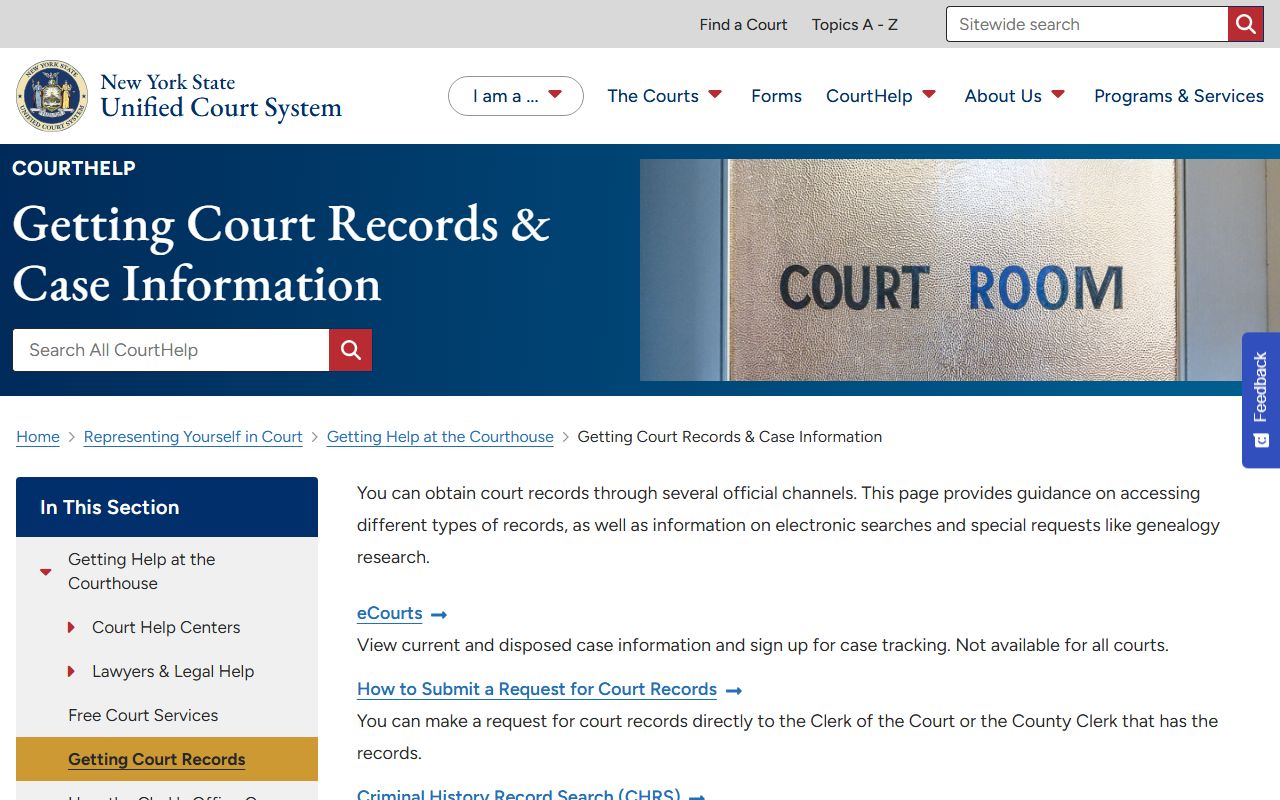
That distinction is important when an Allegany County arrest ends in dismissal or another favorable termination and the public record no longer matches the original booking record.
Background Check Considerations
Casual court lookup is not the same thing as a legally compliant background check. Employers, landlords, insurers, lenders, and other decision-makers must use proper consumer-reporting channels and follow federal and state law. Court websites, jail rosters, and clerk indexes can be incomplete, delayed, sealed, or limited by record-access rules.
Important: Allegany County Inmate Population is not a consumer reporting agency and cannot be used for FCRA-covered decisions.
Restricted Court Records After an Arrest in Allegany County
Some arrest-related court records are not fully public. Juvenile and youth matters may be handled under separate confidentiality rules. Sealed cases, dismissed charges subject to sealing, records tied to an ongoing investigation, and records whose disclosure would invade privacy or interfere with enforcement can be withheld or limited. Public Officers Law Article 6 makes agency records presumptively accessible, but Public Officers Law sections 87 and 89 contain exemptions and access procedures.
For current court location and clerk information, use the official Allegany County Court page.
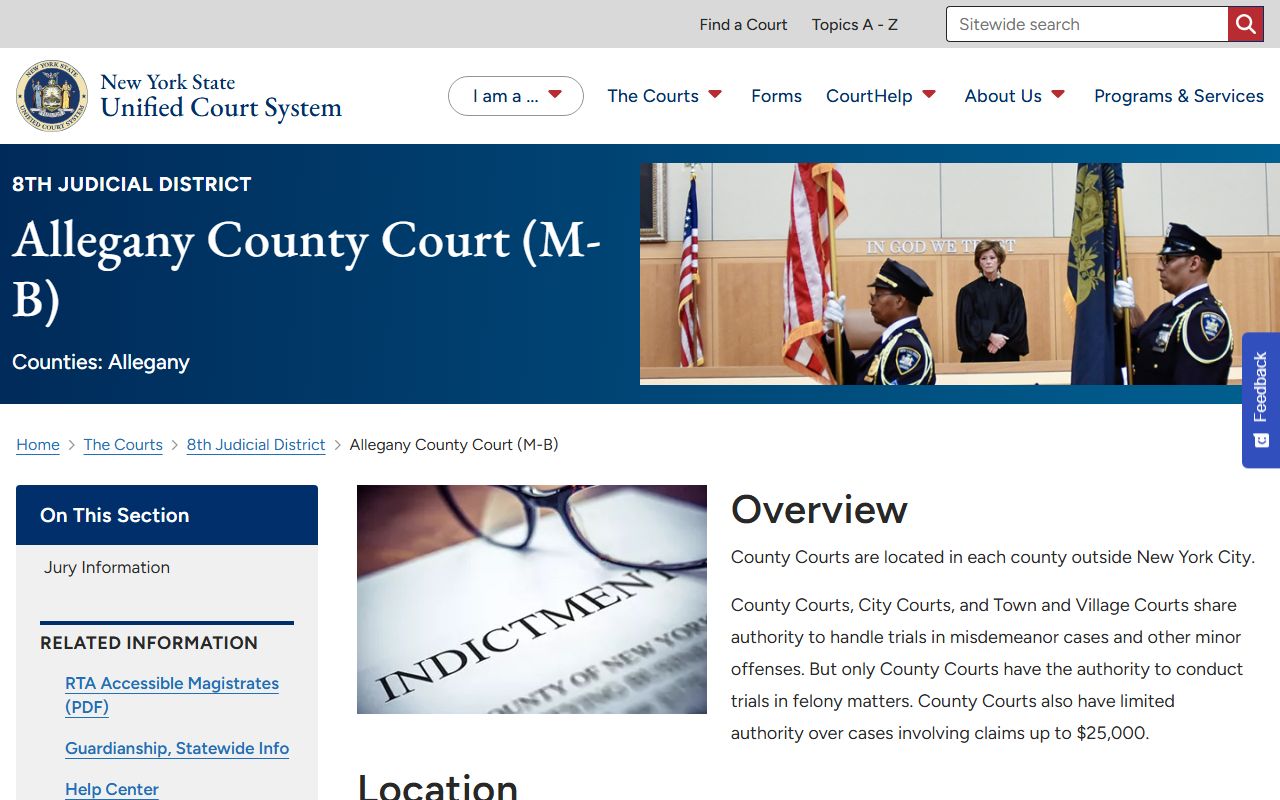
Use the court page and the county court schedule to route the request to the right clerk rather than sending court-record questions to the jail roster channel.